


Introduction
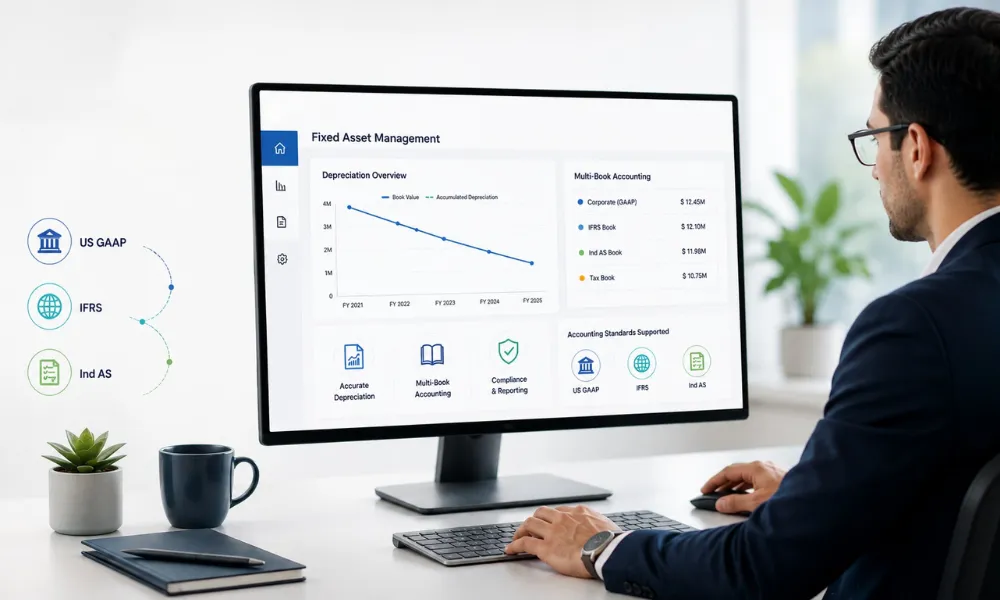
Oracle Fixed Assets in E-Business Suite and Oracle Fusion Cloud provide the subledger for fixed asset accounting, covering books, categories, mass additions, CIP, depreciation, retirements, and posting to the general ledger. SAP fixed asset management handles the equivalent accounting discipline through its FI-AA component.
Both systems manage the financial record; neither is designed to perform physical asset verification on the floor. That is where an ERP control layer such as AssetCues fits. Read this guide in that order: what the module covers, which official user guide answers which job, where registers break in practice, and how the control layer closes the loop, with Oracle staying the system of record throughout.
What Oracle Fixed Assets Covers (EBS & Fusion Cloud)
The module’s scope, in one map, the working vocabulary carries across both platforms even where the interfaces differ:
Capability |
What the module does |
|---|---|
| Asset books | Corporate and tax books carry parallel values per asset under the book controls you configure |
| Categories & flexfields | Categories drive default accounts, lives and methods configuration decisions every later record inherits |
| Mass additions | The front door: Payables lines, project costs and FBDI imports become asset records through prepare, merge, split and post |
| CIP | Construction-in-process assets collect costs until placed in service, then capitalize |
| Depreciation | Periodic runs post depreciation per book across the asset base. |
| Transfers & retirements | Location, custodian and cost-center moves; retirements with or without proceeds, with derecognition |
| Accounting & reconciliation | Asset transactions post to the ledger; the clearing account ties additions back to their sources |
The Oracle Cloud Fixed Assets User Guide
Searches for the Oracle Cloud Fixed Assets user guide lead to several documentation sets, so the challenge is knowing which one to open. Oracle’s documentation is useful once you match the guide to the job. The map, by job:
You need to… |
The official guide that covers it |
|---|---|
| Configure books, categories, flexfields, system controls | Implementing Assets (Oracle Fusion Cloud Financials) |
| Run daily operations: additions, adjustments, transfers, retirements, depreciation | Using Fixed Assets (Oracle Fusion Cloud Financials) |
| Import assets and mass additions in bulk | FBDI templates and import documentation |
| Operate the E-Business Suite module | Oracle Assets User Guide (EBS) |
Start from Oracle’s Fusion Financials documentation. The Implementing Assets guide linked here is the 26B release path and select your release. This guide stays release-neutral by design: the controls around the module do not change with the interface.
The Mass Additions Front Door and Where It Breaks
Almost everything that goes wrong with Oracle registers walks through mass additions: invoice lines become assets based on decisions made at a screen, usually from invoice text alone. The failure modes recur NEW lines aging unowned in the queue, merge and split decisions made without receipt knowledge, capitalization from the invoice date while the crate sits unopened, and a clearing account whose aged balances nobody investigates by cause.
Capture at goods receipt identity, condition, location, readiness so the queue decision is made with the equipment in view. That is capitalization control, the first of the layer’s three components, and it starts before the Oracle record exists.
CIP and the Placed-in-Service Moment
CIP assets carry the same pattern at project scale: costs collect while equipment is built or installed, and the placed-in-service decision the moment depreciation should begin depends on readiness evidence the module cannot gather for itself.
Lifecycle drift first surfaces numerically when CIP balances keep aging despite equipment already being in operation; field-captured readiness certification is the control that closes this gap
Where Oracle Registers Break: The Six Points
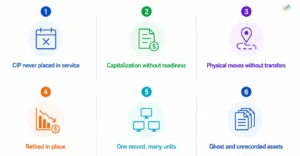
Six break points recur across Oracle environments, each one a posting and a physical event happening separately:
Sr. No |
Break point |
What Oracle shows |
What the floor shows |
|---|---|---|---|
| 1 | CIP never placed in service | Balances aging on CIP while depreciation waits | Equipment commissioned and running for months |
| 2 | Capitalization without readiness | An active record from the invoice date | Item still in a crate, or installed elsewhere |
| 3 | Physical moves without transfers | Original location, custodian and cost center | Asset two sites away since last year |
| 4 | Retired in place | Depreciation still posting each period | Scrapped, cannibalized or sold informally |
| 5 | One record, many units | A single line for a bulk purchase | Multiple physical units, individually loseable |
| 6 | Ghost and unrecorded assets | A register neither audit nor floor fully matches | Items with no record; records with no item |

The ERP Control Layer for Oracle
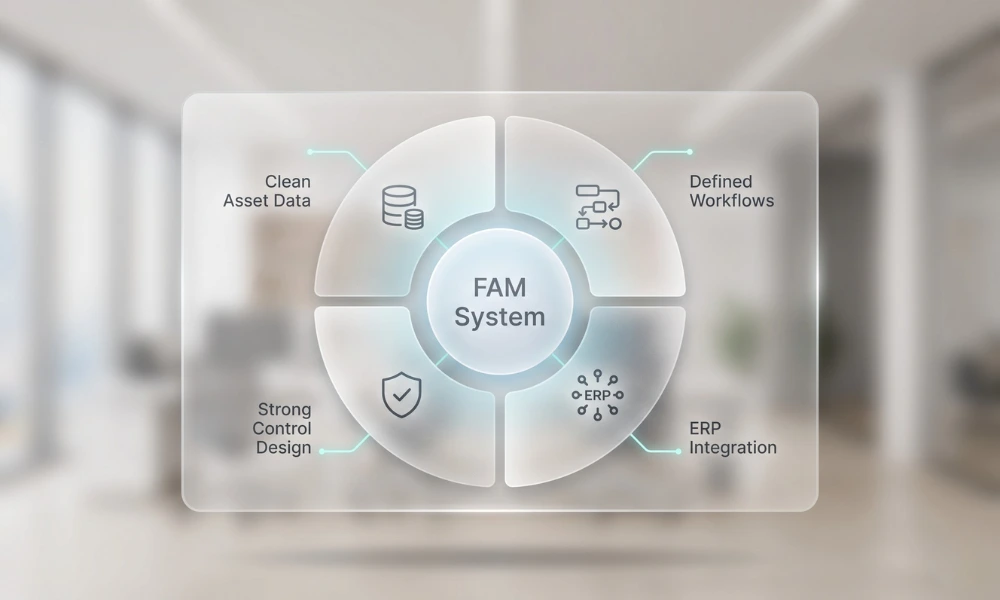
The remedy is the ERP control layer, and that layer is AssetCues: Oracle keeps the accounting; AssetCues keeps the record true to the floor. Three components, one platform capitalization control upstream, verification and tagging in service, and FAR accuracy through continuous reconciliation.
In service it works like this: Every unit is tagged and linked to its Oracle asset number; mobile, AI-powered verification scan validation, image and condition recognition, proving existence, location, and condition with evidence; exceptions routed through approval with reviewer governance; and approved results written back to Oracle automatically, so the register and the floor converge between audits rather than at them.
The loop-closer is the front door itself: Unrecorded assets found in the field become controlled, evidenced lines routed to Finance through mass additions; formation decisions made with the equipment in view, not from invoice text. Verification feeding the queue is what makes the fixed assets Oracle carries provable end to end.
Integration: Fusion Cloud and EBS
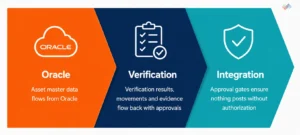
The connector pattern is identical on both platforms: Asset master data flows from Oracle; verification results, movements, and evidence flow back through approval gates; nothing posts without authorization.
Fusion Cloud integrates against the modern module, EBS against Oracle Assets Classic. The platform changes internals, not the operating model, which is why one control layer serves organizations mid-migration, running both. The same pattern extends to netsuite fixed assets deployments through a separate prebuilt connector.
AssetCues runs enterprise verification, tagging, and register programs against Oracle environments across manufacturing, pharmaceutical and diversified groups, with results synchronized back under approval. Client-specific figures appear only with permission; we are compiling register-accuracy benchmarks from Oracle environment projects, and figures are published once internally verified.
Key Takeaways
- Oracle Fixed Assets does the accounting with discipline books, categories, mass additions, CIP, depreciation and none of it proves the floor.
- Open the right official guide by job: Implementing Assets to configure, Using Fixed Assets to operate, FBDI to import, the EBS user guide for classic.
- Registers break at six recurring points, all variants of one gap: postings and physical events happening separately.
- The ERP control layer closes it: capitalization control at receipt, AI-powered verification in service, FAR accuracy through automatic write-back with Oracle as the system of record throughout.
- Unrecorded finds route back through mass additions as evidenced lines the front door becomes the loop-closer.
Conclusion
Oracle Fixed Assets provides the accounting foundation for books, mass additions, CIP, depreciation, transfers, and retirements, but it does not prove what exists on the floor. Therefore, organizations need a control layer that connects physical verification, capitalization readiness, and register accuracy with Oracle.
With proper tagging, verification, and reconciliation, teams can keep Oracle as the system of record while continuously aligning financial records with physical assets. Ultimately, this approach closes the gap between what Oracle records and what the business actually owns and operates.
Oracle Fixed Assets FAQ
Q1. What is the mass additions process in Oracle Fixed Assets?
Ans: Mass additions is the queue that turns source lines into assets: Payables invoice lines flagged Track as Asset, capitalizable project costs and FBDI imports land as lines, get prepared merged or split, categorized, assigned location, owner and a date placed in service and posting creates the assets and applies cost adjustments to existing ones.
Q2. What does the Oracle Cloud Fixed Assets user guide cover?
Ans: Two official guides split the job: Implementing Assets covers configuration books, categories, flexfields, system controls while Using Fixed Assets covers daily operations: additions, adjustments, transfers, retirements and depreciation. Bulk work runs through FBDI templates. Pick the guide by task and release; the concepts are stable even where interfaces differ.
Q3. What is the difference between a corporate book and a tax book?
Ans: A corporate book carries the values your financial reporting uses; tax books carry parallel values under tax rules, per jurisdiction. One asset lives in both, depreciating differently in each, and the book controls you configure determine methods, calendars and allowed transactions. Configure books deliberately at implementation every asset afterwards inherits those choices.
Q4. How is Oracle Assets different in EBS versus Fusion Cloud?
Ans: The concepts carry over books, categories, mass additions, CIP, depreciation while the interfaces, tooling and integration surfaces differ: Fusion Cloud runs the modern module with FBDI-based imports; EBS runs Oracle Assets classic. Verify release-specific behavior in the official documentation for your platform; a control layer built for both serves environments mid-migration.
Q5. Does Oracle Fixed Assets handle physical verification?
Ans: The module records and accounts for assets; walking the floor is outside its documented scope. Physical verification for Oracle environments runs as AssetCues’ layer: AI-assisted mobile counts with scan and photo evidence against asset numbers, exception workflows, approved results written back automatically and unrecorded finds routed into mass additions as controlled, evidenced lines.